[ ACT III · THE DIGITAL AFTERLIFE ]
What Happens When a Cultural Object Enters the Consumer Internet
Everything described in Act I happened in physical space: in workshops, on streets, between people. But the Wamao’s second life takes place on screens. To understand what becomes of this object once it leaves Yuxi’s kilns and enters China’s digital consumer ecosystem, I turned to Xiaohongshu (Little Red Book), the country’s dominant lifestyle and shopping platform.
My question was specific: when ordinary people encounter the Wamao online, do they engage with it as a cultural object (something with a history, a region, a ritual meaning), or do they treat it as a product to purchase and display?
The Data
Using a keyword-based web scraper, I collected 200 posts tagged or titled with “Wamao.” Each post’s full text was extracted and classified into one of six content categories using AI-assisted categorization. Posts that used “Intangible Cultural Heritage” language or historical narratives specifically as a sales frame, rather than as genuine cultural discussion, were flagged separately.
[ Animated · scroll ]
200 posts, sorted
Scroll: every dot is one Xiaohongshu post tagged 瓦猫, sorting itself into six kinds of attention — and then into the 80 / 20 split.
n = 200 posts, collected June 2025.
Each post’s full text was extracted and classified into one of six content categories.
Eighty percent of the content treats the Wamao as something to buy, visit, or experience.
Only one in five posts engages with what the object is or where it comes from.
Eighty percent of the content treats the Wamao as something to buy, visit, or experience. Only one in five posts engages with what the object is or where it comes from. The word “Intangible Cultural Heritage” appears frequently in the consumption-oriented posts, but almost always as a marketing label, not as a subject of discussion.
What Disappears Online
[ Animated · scroll ]
Five forms become one
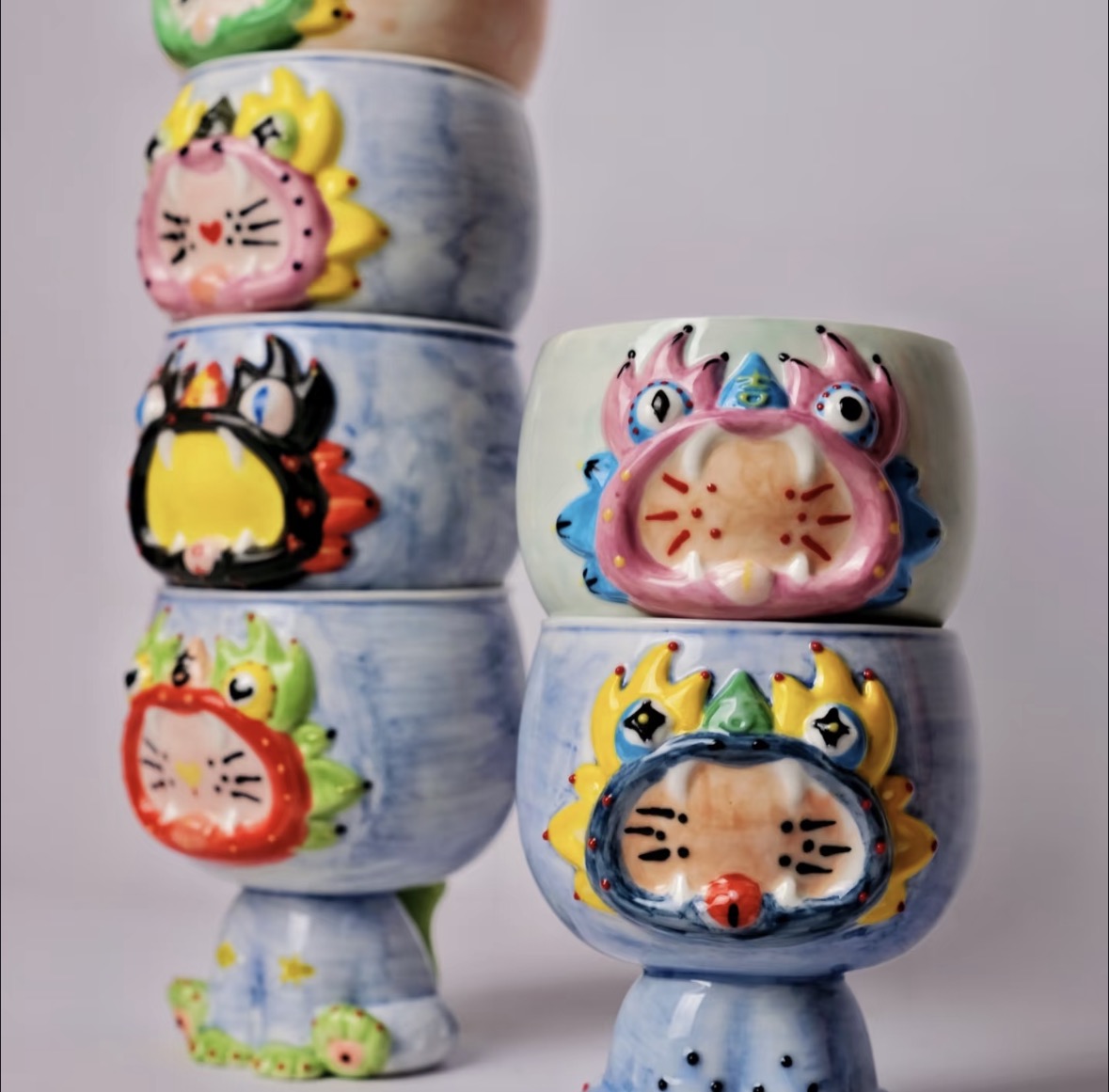
Scroll: the five regional varieties of the Wamao collapse into the single small, cute, big-mouthed image the platform rewards.
The academic literature records a striking diversity of Wamao forms across Yunnan.
None of this variety is visible on Xiaohongshu.
What consumers see is one image, repeated with minor variations: a small, round, cute creature with a big mouth and bright colors.
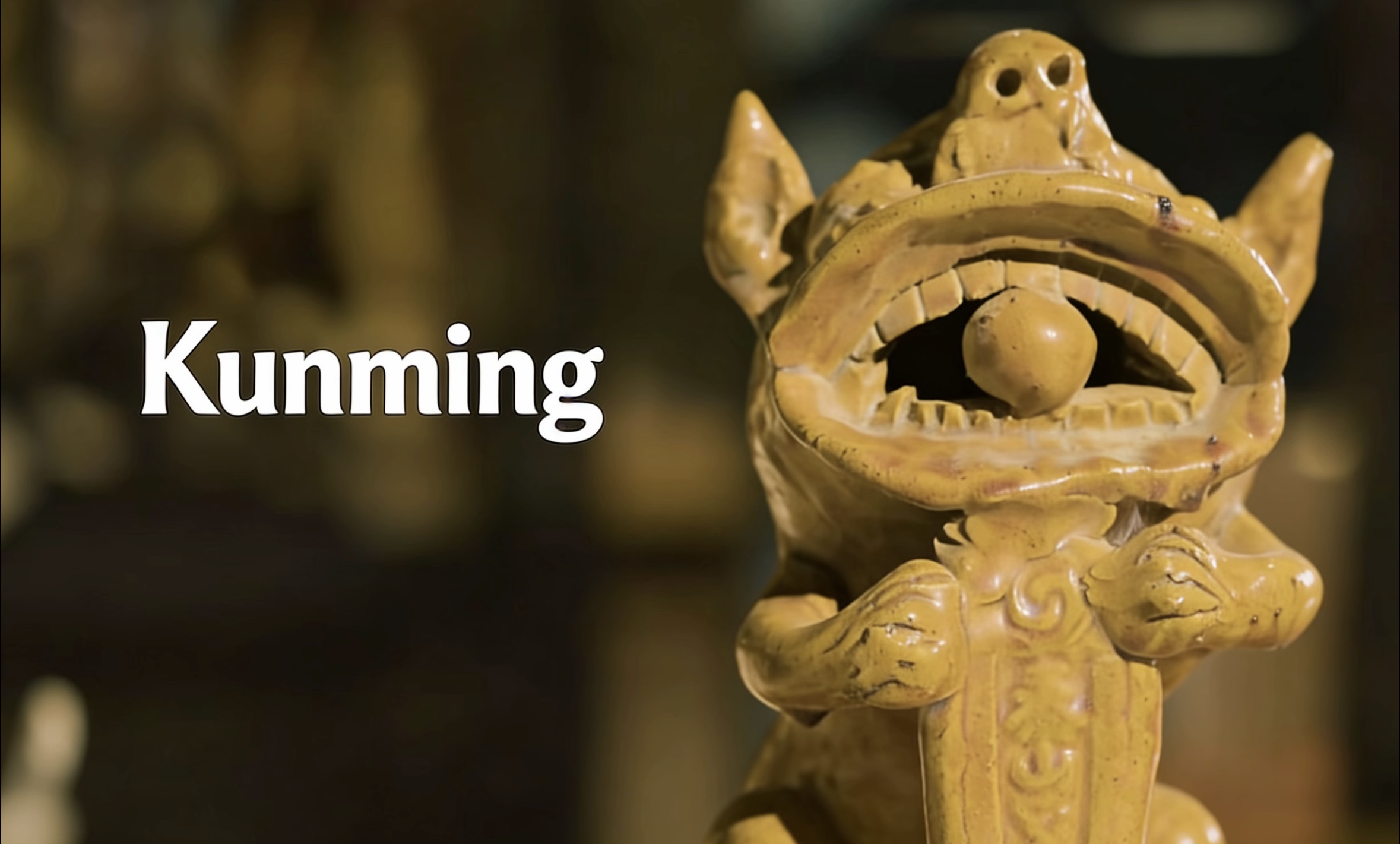
a single horn and a gaping red mouth
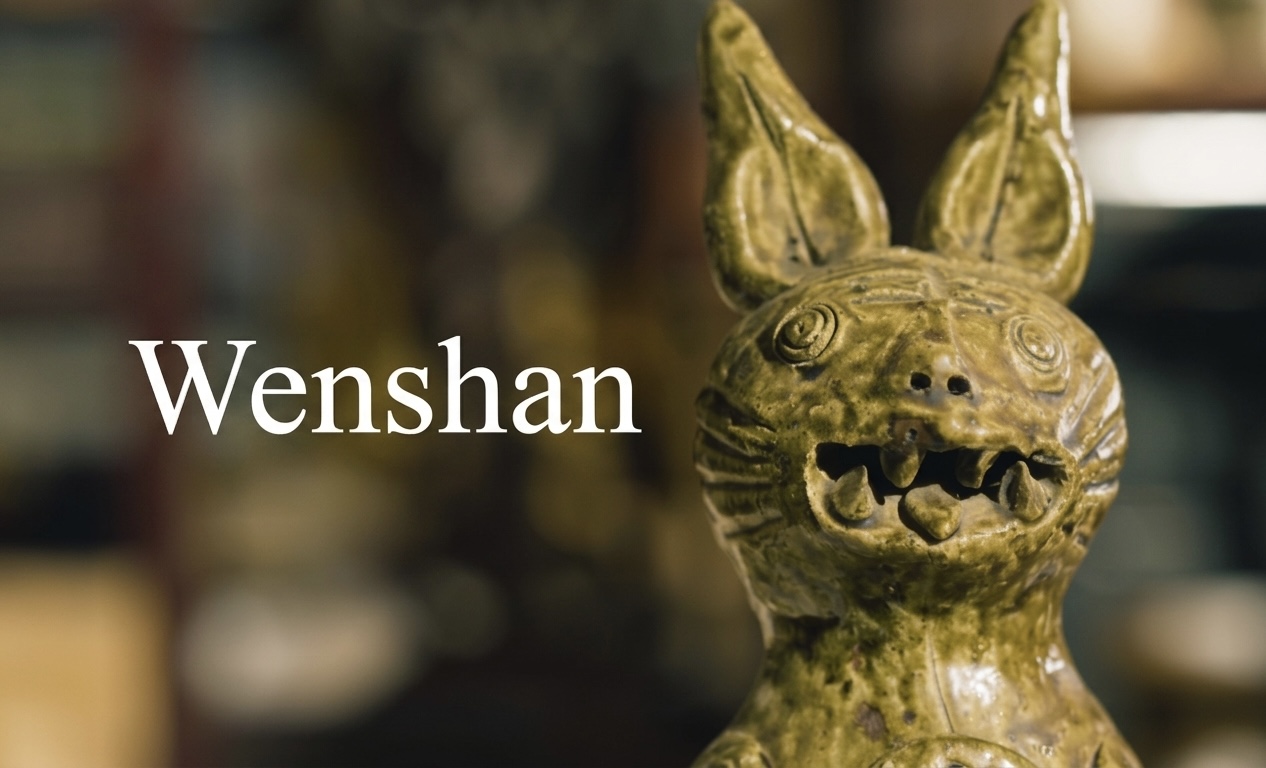
four nostrils and four ear-holes
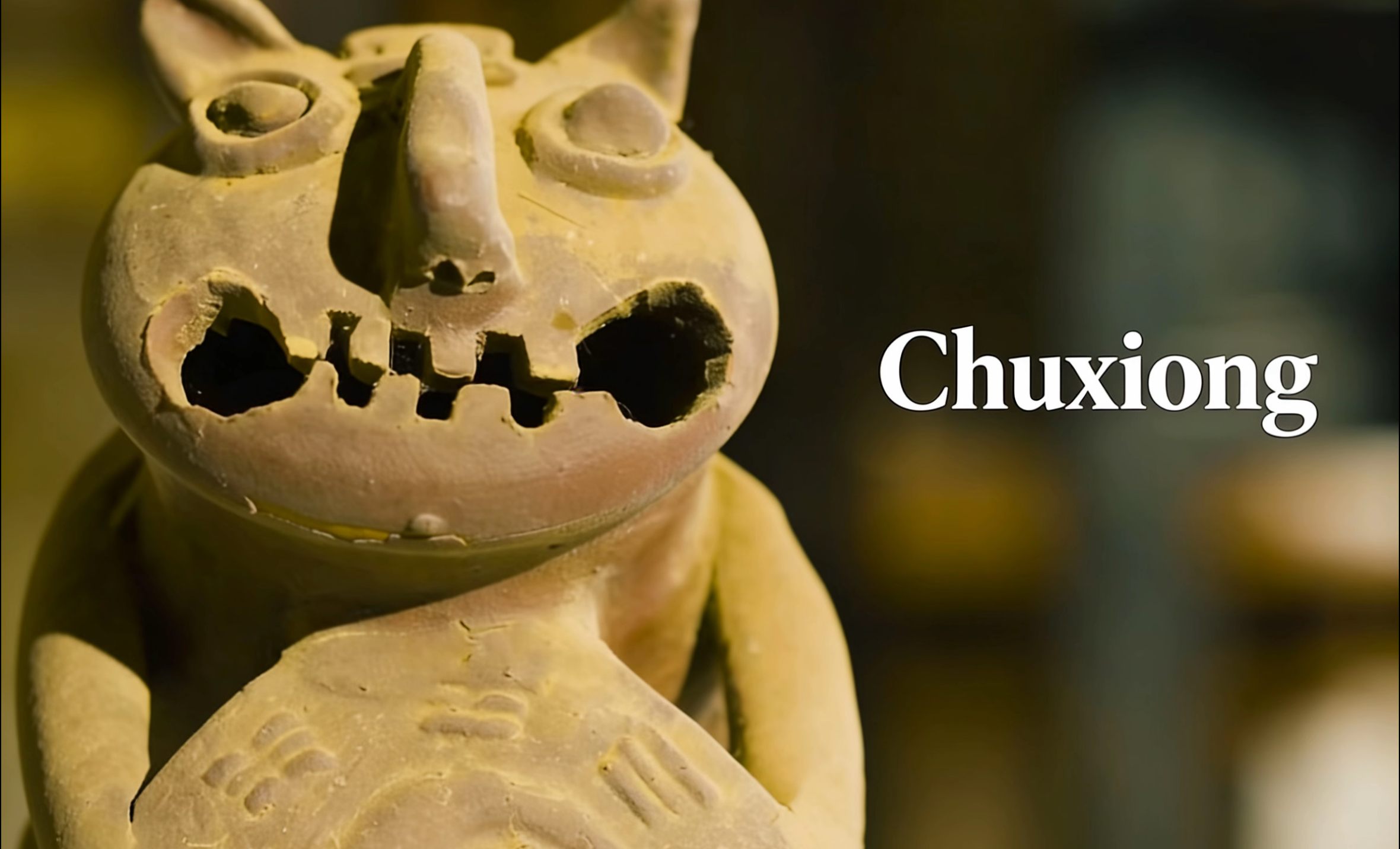
Heqing’s ridge-taming tiger, Chuxiong’s stone cat, Jianchuan’s unicorn: none of these survive the platform. What spreads instead is the same standardized form, made to photograph well and sell fast. The ethnographer Ma Jia (2022) documented that in Heqing itself, a traditional system of eleven Wamao categories (each corresponding to a specific house orientation and protective function, with names like “Welcoming Fortune” and “Gazing at Prosperity”) has largely disappeared. The now-iconic “big round face” of the Heqing Wamao turns out to be a relatively recent innovation, developed in the 1980s by the artisan Gao Jinfu; older examples had more three-dimensional, tiger-like or qilin-like features (Ma Jia, 2022; independently confirmed by Cao Anli & Xin Beini, 2025). Even within what passes for “tradition,” forms have been standardized and simplified over the past four decades.
What the digital platform does is accelerate this process to its logical endpoint. In Heqing, the flattening took forty years and left traces: old villagers still remember the categories; a few artisans still experiment. Online, the flattening is instantaneous and total. A post performs well or it doesn’t. An image gets shared or it doesn’t. The algorithm does not care whether a Wamao has one horn or four nostrils, whether it was fired in a coal kiln for seventeen days or mass-produced in a factory. It cares about engagement. And engagement, on Xiaohongshu, is driven by cuteness, novelty, and price.
What Li Ping Understood
Li Ping, the Wamao Daren founder, grasped this logic before I had the data to confirm it. Her description of the Wamao as something that “was never anything to begin with” is not cynicism but market intelligence. She knows that the object’s lack of a fixed identity is precisely what makes it adaptable to whatever the platform rewards. Her frustration is not that the Wamao has no tradition; it is that no one has yet figured out how to manufacture a compelling one.
The mechanism is the same; the actors have changed.
Her word for it, “laundering,” is more exact than it first sounds. The Wamao isn’t fake; it just doesn’t mean much on its own. What she adds is the meaning: a story, a look, a presence on the feed, repeated until people take it for granted. This is, in functional terms, what the historian Eric Hobsbawm (1983) called “the invention of tradition,” except that Hobsbawm imagined the process being driven by states and elites. Li Ping is doing it from a residential apartment with a packing table and a Xiaohongshu account. The mechanism is the same; the actors have changed.
The Three Compressions
Taken together, the journey from Heqing’s ritual rooftops to Yuxi’s Xiaohongshu feeds traces a pattern of progressive compression:
Ritual compressed into object. In Heqing and Binchuan, the Wamao is activated by ceremony: rooster blood, prayers, an auspicious date. Without the ritual, as the Binchuan geomancer put it, it is “just a lump of clay.” In Yuxi, the ritual has been stripped away entirely. The object is sold as-is, with no activation required and none expected. What once needed a geomancer, a carpenter, and a prayer now needs only a price tag.
Object compressed into brand. In the villages, each Wamao was shaped by hand for a specific house, a specific ridge, a specific set of spiritual circumstances. In Yuxi, the object has become a product line: Li Ping’s “Wamao Daren” series, Zheng Popo’s wholesale batches, Yang Ayi’s cup attachments. The figure no longer sits on a roof. It sits on a shelf, waiting to be picked.
Regional form compressed into platform meme. Across Yunnan, the Wamao exists in at least five distinct stylistic families, each tied to a specific ethnic group, geographic zone, and belief system. On Xiaohongshu, all of this collapses into a single image: small, cute, colorful, mouth open. The platform does not distinguish between a Heqing ridge-tamer and a Yuxi desk ornament. It does not need to. The consumer doesn’t ask.